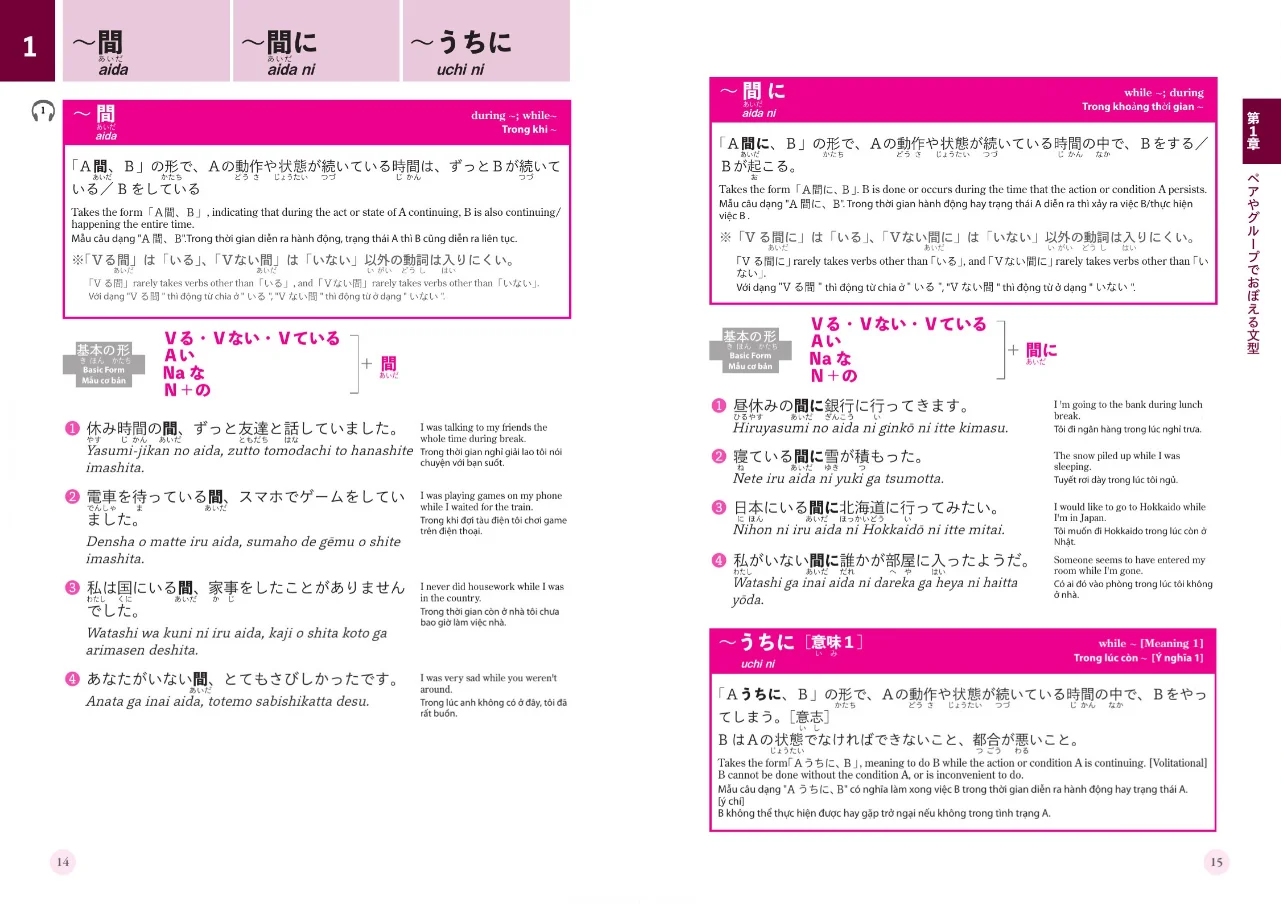
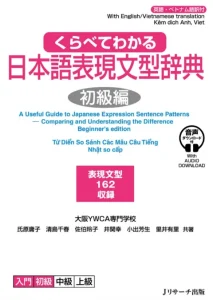
This book is aimed at N4 and N5 learners who want extra grammar practice. It takes a comparative approach, showing how closely related grammar points overlap and differ.
Many beginners struggle with expressions such as jouzu and heta when referring to themselves or others, but these can sound unnatural because they come across as boastful. This book shows learners what to use instead, such as tokui in place of jouzu, or negative forms instead of heta.
The book is mainly written in English and Vietnamese, so the explanations are easy to understand. One drawback is that many examples of different grammar patterns are listed with explanations of the differences, but the example sentences themselves and how they differ are only shown in Japanese.
This can limit the book’s usefulness for beginner students, because the untranslated information is often the most important part. For that reason, we recommend picking up A Dictionary of Basic Japanese Grammar before this book.
The grammar examples are grouped by type in hiragana order, which helps students drill down into the differences between grammar points they are unsure about. For example, grammar such as し, which is taught in Genki 1, and たり, which appears in Genki 2, are often learned far apart, so students may assume they are interchangeable when they are not. Kurabete wakaru places these forms next to each other to make sure they are learned properly.