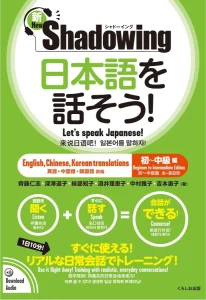
Shadowing is a slightly unusual book when looked at as a “Japanese textbook”, landing somewhere between speaking practice and immersion. While there is not much direct teaching of Japanese, it does help learners get used to sentences they might hear, as well as give plenty of practice with, well… shadowing.
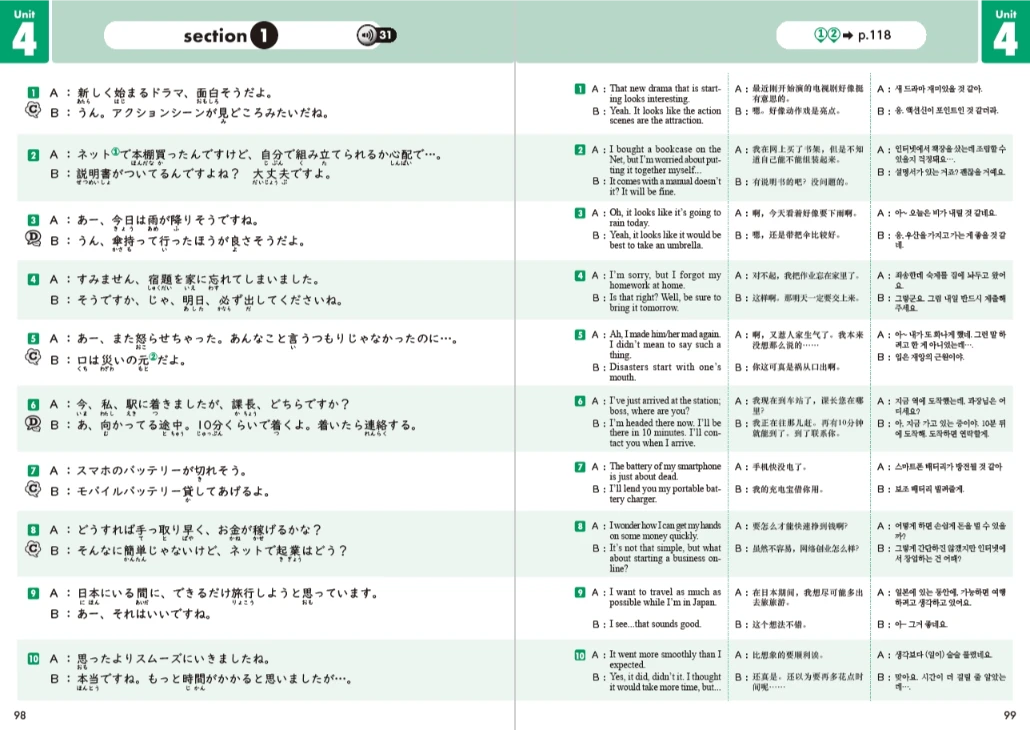
The annotations are quite useful, with symbols that show when sentences are casual or polite, as well as when the responses are a mix of speech styles, such as those between junior and senior speakers.
Sentences are shown in Japanese, along with English, Korean, and Chinese translations. Getting the most out of the book can feel a little clunky, as you need to flick back and forth because the cultural and linguistic explanations are in the footnotes toward the end of each section. This would be easier to navigate if it were just Japanese and English, but the multiple translations taking up space are to be expected with many Japan-focused Japanese textbooks.
As mentioned earlier, this book breaks from the norm of standard textbooks, and part of that difference is the range of Japanese it covers, from roughly N5 all the way up to N2-level tasks.
Unit 1 covers roughly the material of
Genki 1,
and Unit 2 lines up with
Genki 2.
While it does cover familiar textbook material, there are also words and phrases that are much more casual, so you are likely to see things that do not show up in the usual books.
It is a good speaking resource for self-studiers who do not have anyone to practice with. Being able to read and listen while paying attention to the tone and intonation of responses can help your Japanese sound more natural over time. Of course, watching TV shows can also help with this.